
One of the biggest challenges teachers in a Core French classroom often face is getting students to speak in French.
We model using the language, we encourage our students, we provide word banks and word walls and yet we hear nothing but silence sometimes.
Why?
Because they’re unsure.
Because they’re afraid to try and get it wrong.
Because they are overwhelmed.
Because they need support.
And that’s where visuals come in.
It’s not about having a Pinterest-worthy classroom—it’s about making things clearer, simpler, and more doable for both you and your students.
When students can see the language, the expectations, and the structure… they’re more willing to try.
Visuals create clarity—and that clarity builds confidence.

We all want our students to feel ready—to participate, to speak, to take risks in French. But readiness doesn’t just happen. It’s something we have to build.
Visuals help us do that. Let’s talk about how.
Here are a few ways how visuals help us unlock speaking:
- Visuals reduce the cognitive load for our students. This means they have one less thing to worry about while trying to juggle grammar, pronunciation, comprehension, and confidence all at once.
- They make abstract ideas more concrete so students can better understand what is being asked of them and thereby participate.
- Visuals normalize support so no student is left feeling like they require more support than their peers. This in turn gives them the tools that they need to try.
- They reduce the number of times we have to explain things to our students because they make expectations visible leading to more independent learners.

The types of visuals that I like to use in my classroom can be broken down into three simple categories:



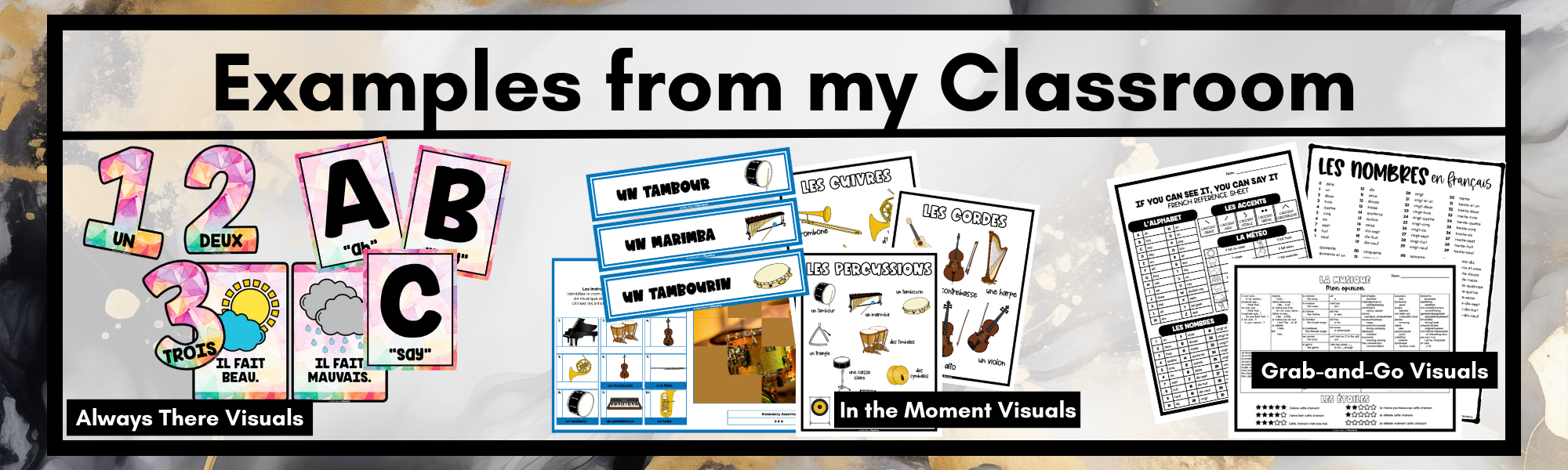
Always there visuals are visuals that you would typically put up in September and they would stay there for a good chunk of the year, if not for the entire school year. For example, these are your calendar and weather cards, your classroom questions and phrases posters, or your verb posters. These are available for students to reference anytime and are referred to often.
Next, we have in the moment visuals. These are visuals that students would need in a specific moment. For example, these are your daily slides, your lesson slides, or your sample work examples. These visuals are available as and when needed, specific to what the students are learning in the classroom.
Lastly, we have grab and go visuals. These are the visuals that students can access when needed. These include your reference sheets and your chat mats, to name a few. Students know how to locate these tools and access them as and when they are needed.
Let’s bring it home with some examples from my classroom.

As you wrap up reading this post, use this as an opportunity to self-assess the use of visuals in your classroom. Here are some questions you could ask yourself:
- Do my visuals actually support speaking, or are they just decorative?
- Can my students see the language they’re expected to use?
- Which category needs the most love in my classroom—always there, in the moment, or grab-and-go?
- Have I explicitly taught students how to use the visuals, or did I just put them up?
- How can I use visuals to reduce the amount of English students ask me for in class?
- What’s one visual support I want to try—or rethink—this year?

As you reflect on your answers to the self-assessment questions, remember that you don’t have to overhaul your classroom overnight. Even one or two intentional visuals can make a big difference for you and your students. All you need to do is look at where you are currently strong and think about where you need to grow and choose one thing to try.
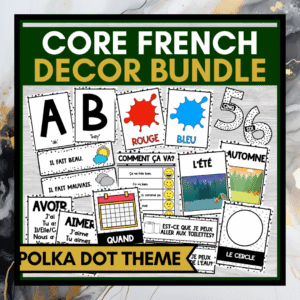
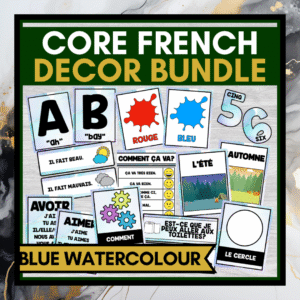
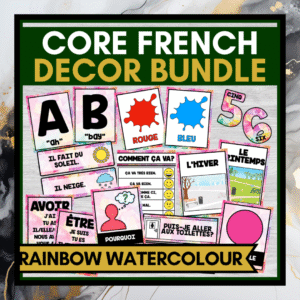
If you’re not sure where to start, I’ve made it simple. I’ve put together multiple decor bundles that will not only help take some pressure off your plate, they will also help in getting your students to speak French.
Check them out below!


Great post and presentation! Have you ever taught core French without a Classroom? That’s the case for so many of us in Ontario and it’s a struggle to provide these supports when you are moving from class to class. Any suggestions?
Hi there,
That’s a very interesting point that should have been in my post itself!
Managing visuals while teaching Core French on a cart is a completely different ballgame.
Here are some of the strategies for visuals that I used while teaching Core French on a cart:
– Always There Visuals: If possible, ask for some bulletin board/wall space in the classroom. Since this is often not realistic, think digital. I would put up my calendar and routine slides as soon as I would enter the classroom. Students would be working on bell-work at this time. When I was ready with my slides, we would begin our calendar routine. Additionally, students had reference sheets in their duotangs to which they could refer. I used a combination of both of these methods.
– In the Moment Visuals: These are again often digital (images on a slide during a lesson) but can also be written/drawn by hand on the white/black board as needed. They could also be on worksheets or printed and laminated activity sheets.
– Grab-and-Go Visuals: Think flashcards on rings and laminated reference sheets at the back of the room (or in a bin that you bring to class). These give students quick access to supports they can use during partner work, writing, or review without waiting for you to provide the visual.
A few other tips:
– I gave a lot of the ownership and responsibility to students (I was teaching 6-8 French so it was a little easier!). We spent a lot of time setting our practices and procedures in place and rehearsing them. This way students knew where to turn and for what visuals.
– I also really loved magnetic tape. Anything that I needed for the students to refer to, I could easily stick some magnetic tape on it and put it on the board as soon as I came in to the classroom.
– At the start of the school year, direct students towards using the visuals as much as possible. The more you direct, the more routine it becomes for them and the less you have to deal with.
Lastly, you can check out my blog post on teaching Core French à la carte for any more ideas that may be relevant to you.
https://mmeir.com/2021/09/teaching-core-french-a-la-carte/
Thanks for reading and leaving such a valuable comment!